On this page
- Turkish Angora at a Glance
- Where the Turkish Angora Comes From
- Turkish Angora Cat Personality
- Coat, Colours and Eyes
- Turkish Angora vs Persian Cat
- How to Tell If a Cat Is a Real Turkish Angora
- Turkish Angora Cat Care in Pakistan
- Health and Turkish Angora Cat Lifespan
- Turkish Angora Cat Price in Pakistan
- Before You Buy a Turkish Angora Kitten
- Frequently Asked Questions
- Final Thoughts
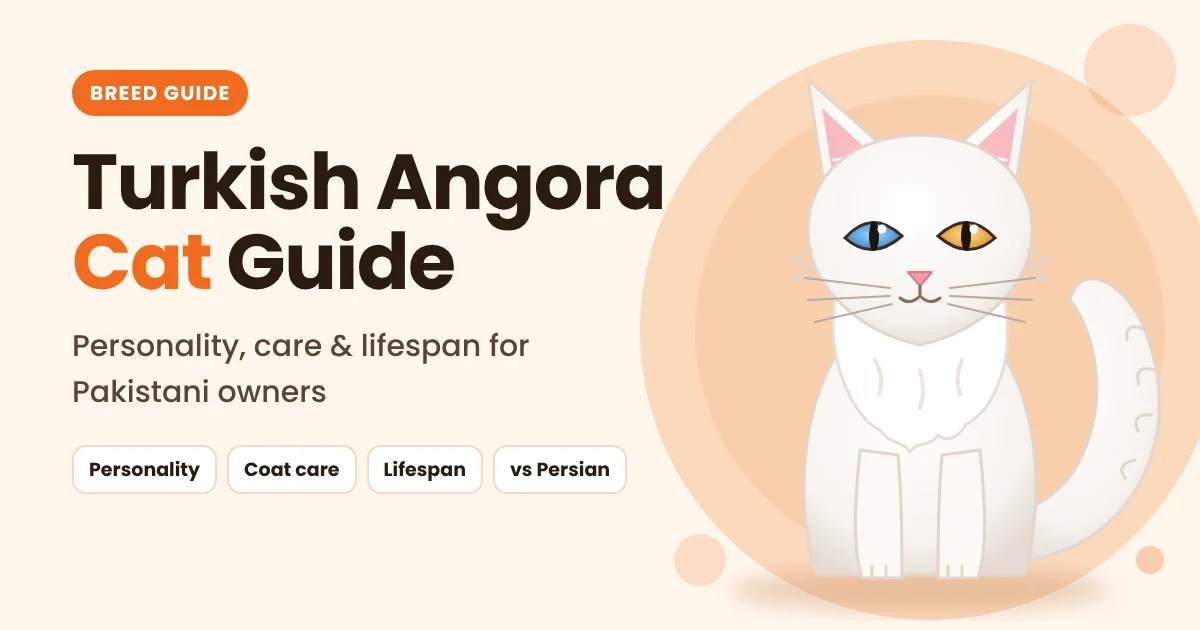
The Turkish Angora cat is one of the oldest natural cat breeds in the world, known for its silky coat, plumed tail and lively, people-loving nature. In Pakistan, the name "Angora" is often used for any long-haired white cat, so many buyers are not sure what a real Turkish Angora looks like or how it differs from a Persian.
This guide covers the breed's history, personality, coat and colours, how it compares with a Persian, day-to-day care in Pakistan's climate, health and lifespan, and what to check before you bring a kitten home.
Turkish Angora at a Glance
| Trait | Details |
| Origin | Ankara region, Turkey |
| Size | Small to medium, about 2.5 to 4.5 kg |
| Coat | Single, silky, medium-long coat with no thick undercoat |
| Colours | White is best known; also black, red, cream, blue, tabby and more |
| Eyes | Blue, green, amber or odd-eyed |
| Lifespan | Often 12 to 18 years with good care |
| Energy | High; playful and curious |
| Grooming | Brushing once or twice a week |
Where the Turkish Angora Comes From
The breed takes its name from Ankara, once called Angora, in central Turkey. Long-haired cats from this region reached Europe centuries ago and later helped shape other long-haired breeds. In the twentieth century, Turkey began a breeding programme at the Ankara Zoo to protect the white, odd-eyed Angora, and the breed is now recognised by major cat associations around the world.
Turkish Angora Cat Personality
A Turkish Angora is active, clever and very social. It likes to follow its owner from room to room, join in with whatever is happening and climb to the highest spot in the house. Many learn to open cupboards or play fetch, and some even enjoy splashing in water.
Because they are so energetic, they do best in homes where someone has time to play each day. A bored Angora can become noisy or mischievous. They usually get on well with gentle children and calm pets, although they like to be in charge.
Coat, Colours and Eyes
The coat is fine and silky, longest on the tail, neck ruff and back legs. Unlike a Persian, a Turkish Angora has no dense undercoat, so it mats less easily and is simpler to groom.
Pure white is the colour most people picture, but the breed comes in many colours and patterns, including black, red, cream, blue and tabby. Eye colour can be blue, green, amber or odd-eyed, where each eye is a different colour. Odd-eyed white kittens are especially popular with buyers in Pakistan.
Turkish Angora vs Persian Cat
| Feature | Turkish Angora | Persian |
| Head and face | Wedge-shaped head with a straight nose | Round head; flat face in peke- and punch-face types |
| Body | Long, slim and graceful | Short, solid and stocky |
| Coat | Single, silky coat that mats less | Thick double coat that needs daily brushing |
| Energy | Very active and playful | Calm and relaxed |
| Breathing | No flat-face breathing problems | Flat-faced types can have breathing and eye problems |
If you want a calm lap cat, a Persian may suit you better, and you can compare Persian cats for sale on Titans Pet. If you want an energetic, interactive companion with an easier coat, the Turkish Angora is a strong choice.
How to Tell If a Cat Is a Real Turkish Angora
Pedigree papers are rare in Pakistan, and many cats sold as "Angora" are Persian mixes. Look for these signs:
- A long, slim body and fine bones
- A wedge-shaped head with a straight nose, not a flat face
- Large, pointed ears set high on the head
- A long, plumed tail
- A silky coat without a woolly undercoat
Ask the seller for photos of both parents and any registration papers before you agree on a price.
Turkish Angora Cat Care in Pakistan
Grooming
Brush once or twice a week with a fine comb, and more often during spring shedding. Check the ears weekly and trim the nails every few weeks. You can find brushes, nail clippers and scratchers in our cat accessories listings.
Coping with the Heat
Summers in much of Pakistan are very hot. Keep your cat indoors during the hottest hours, give it shade and plenty of fresh water, and keep at least one room cool with a fan or air conditioning. Ask your vet before shaving the coat, because the fur also protects the skin from the sun.
Food and Water
Feed a good-quality, high-protein cat food that suits your cat's age, and keep clean water available at all times. Ask your vet how much to feed, as active Angoras can burn more energy than calmer breeds. You can compare options in our cat food listings.
Play and Enrichment
Give your Angora a tall cat tree, a window perch and interactive toys. Short, active play sessions two or three times a day help prevent boredom and keep your cat fit.
Health and Turkish Angora Cat Lifespan
With good care, many Turkish Angoras live 12 to 18 years. The breed is generally healthy, but a few issues are worth knowing about:
- Deafness: white cats with blue eyes can be born deaf, and odd-eyed white cats may be deaf on the blue-eyed side.
- Heart disease: hypertrophic cardiomyopathy (HCM) has been reported in the breed.
- Hereditary ataxia: a rare condition in some lines that affects the balance of very young kittens.
Regular vet check-ups, vaccinations and good nutrition all help your cat live a long, healthy life. If a vet has not checked the kitten before sale, book a visit soon after you bring it home.
Turkish Angora Cat Price in Pakistan
Prices depend on age, colour, eye colour and whether the parents are known. Recent listings on Titans Pet range from about PKR 10,000 to PKR 17,000, with pure white and odd-eyed cats at the higher end. For current kittens and prices, see our Turkish Angora cats for sale in Pakistan.
Before You Buy a Turkish Angora Kitten
- Wait until the kitten is at least eight weeks old and eating solid food.
- Meet the kitten, or see it on a live video call, and check that it is active and alert.
- Test its hearing with a soft sound behind it, especially with white or blue-eyed kittens.
- Ask about vaccinations, deworming and the health of both parents.
- Prepare a litter box, food and water bowls and a scratcher before it arrives.
Frequently Asked Questions
Is a Turkish Angora cat rare in Pakistan?
Yes. True Turkish Angoras are less common than Persians in Pakistan, and many cats sold as "Angora" are mixed. Ask for parent photos and papers.
Is a Turkish Angora a Persian cat?
No, they are separate breeds. The Turkish Angora has a slim body, wedge-shaped head and single silky coat, while the Persian has a stocky body, round face and thick double coat.
How long do Turkish Angora cats live?
Many live 12 to 18 years with good food, regular vet care and a mostly indoor life.
Do Turkish Angora cats shed a lot?
They shed moderately, more in spring. Without a thick undercoat, they shed and mat less than Persians.
Are Turkish Angoras good with children?
Yes, they are usually friendly and playful with children who handle them gently.
Final Thoughts
A Turkish Angora suits families who want a clever, playful companion with a beautiful, easy-care coat. Spend time with the kitten, check its health and hearing, and ask about its parents. When you are ready, see the latest Turkish Angora cats for sale in Lahore, where most current listings are.